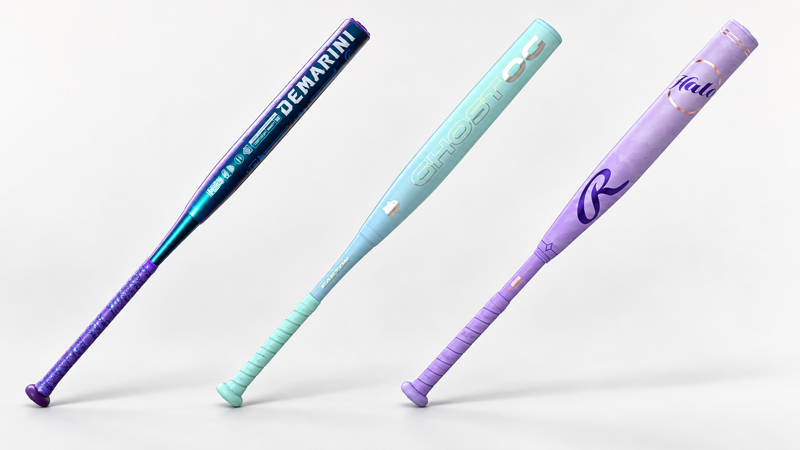
Fastpitch and slowpitch are two forms of softball. A bat made for one may not be suitable for the other. Fastpitch batters react to a faster pitch; slowpitch uses a slower pitch with a required arc. The available bats differ in length, weight, balance and approval marks. Before buying, ask which form of softball your team plays.
This article explains how fastpitch and slowpitch softball bats differ and what to check before buying. For a detailed method to choose length, weight, material and approval marks, see the main baseball and softball bat selection guide.
First, the game: faster pitch and arc pitch
In fastpitch, the batter must react to a faster pitch and bring the bat barrel to the ball in time. In slowpitch, the pitch follows a required arc, so swing timing differs. This does not mean that all fastpitch bats are light or that all slowpitch bats are heavy. In either game, the player must be able to control the bat and make consistent contact.
Fastpitch and slowpitch are not material or brand names. These names describe the type of game for which a bat is designed or marketed. Players of different ages and skill levels play both forms. Do not choose a bat type based on the player’s gender.
Fastpitch vs. slowpitch bats: differences at a glance
| What to compare |
Fastpitch |
Slowpitch |
| At the plate |
Faster pitch; quick timing and control matter. |
Slower pitch with an arc; different swing timing. |
| How weight is usually stated |
Often by using drop, for example −10. |
For adult models, more often directly in ounces, such as 26 or 27 oz. |
| Typical lengths |
Wide range for youth and adults. |
Many adult models are 34 inches long; check the specific bat. |
| Swing feel |
There are balanced and heavier-feeling models. |
Both balanced and end-loaded models. |
| Competition approval |
Approval depends on league rules and the marks on the specific bat, not merely on a store category. |
These lengths and weights are common examples, not universal limits. The range depends on age, manufacturer and league rules.
Why do fastpitch bats often show a drop while slowpitch bats show ounces?
Drop is the difference between bat length in inches and bat weight in ounces. A 32-inch bat weighing 22 ounces has a drop of −10. This makes it easy to compare fastpitch bats of different lengths. DeMarini lists −12, −11, −10, −9 and −8 as common fastpitch options, depending on the player and their swing.
Many adult slowpitch bats have similar lengths, so their weight is often stated directly in ounces. DeMarini lists 26–30 oz for its slowpitch bats. This does not apply to every model. More important is whether you can maintain swing speed and control.
Balanced or end-loaded? That's another question
Balanced means the weight is distributed more evenly, so the bat can feel easier to swing. End-loaded places more weight toward the end of the barrel and can feel heavier during the swing, even at a similar total weight. Both designs exist in softball. Fastpitch does not automatically mean balanced, and slowpitch does not automatically mean end-loaded. When choosing, compare the actual feel with several controlled swings.
Can I use a fastpitch bat in slowpitch, or the other way around?
There is no universal answer. Some leagues allow particular approval marks or exceptions; others have stricter rules. Check your league’s current rules, the mark on the bat, its condition and any inspection before a game. A “fastpitch” or “slowpitch” label alone does not confirm that the bat is allowed in your league.
Before buying, ask your coach or league organizer three questions:
- Do you play fastpitch, slowpitch, or another variation? In what age category and competition?
- Which approval marks and technical requirements does the league accept now?
- Is the bat approved for the ball and the rules used in this tournament?
You may see approval marks from organizations such as USA Softball, USSSA or WBSC. Similar names do not make their marks interchangeable. Requirements can vary between tournaments. Check the organizer’s current rules. In Czech competitions, check the relevant Czech Softball Association specification as well.
A simple way to choose
- Identify the game and its rules. Ask your team which bat types and approval marks are allowed. Then compare eligible models.
- Check whether the bat is manageable. The bat should offer enough reach without slowing the swing. Its weight and balance must suit the player’s strength and technique.
- Compare specific bats. Read the approval marks, check the bat’s condition and try swinging it if possible. For help with length and weight, read how to choose the right baseball or softball bat size.
Three common mistakes
- “It is a softball bat, so it works in every softball game.” The type of game, approval marks and local rules can limit the choice.
- “A heavier bat always hits farther.” Extra weight does not help if it reduces swing speed or control.
- “Bats of the same length feel the same.” Two bats can differ in weight and balance.
FAQ
Is a fastpitch bat always lighter than a slowpitch bat?
The models often differ, but the type name alone cannot tell you which bat is lighter. Compare each bat’s length, weight and weight distribution.
What does the marking −10 mean?
It is the drop: a 32-inch bat with a −10 drop weighs about 22 ounces. Drop describes length relative to weight. It does not state the approval or game type.
Is it enough to find the USA Softball or USSSA logo on the bat?
Not always. Check the exact approval mark, your league’s current rules and the bat’s condition. The organizer decides whether an exception applies.
What next?
Once you know whether you play fastpitch or slowpitch, use the bat selection guide. Then browse the matching category: fastpitch bats or slowpitch bats. Before buying, check the approval mark and size of the chosen bat.
Sources: fastpitch and slowpitch bat characteristics and current rules: DeMarini - fastpitch guide, DeMarini - slowpitch guide and USA Softball - Rules. Your league may have additional restrictions.