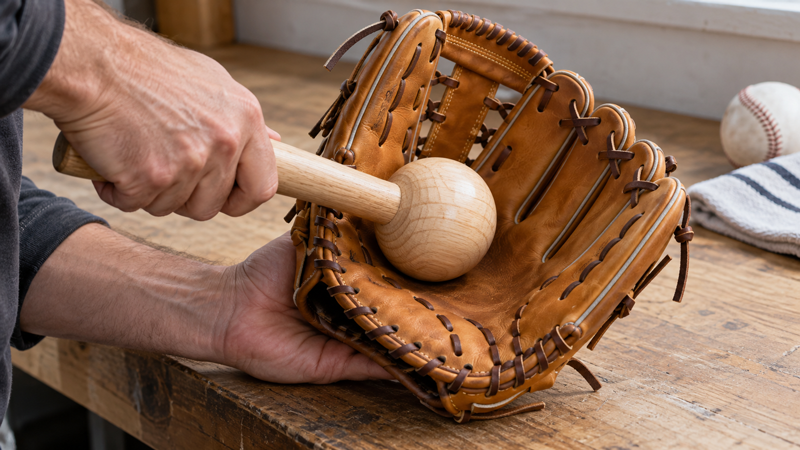
Break in a new glove gradually. Gently loosen the stiff areas near its heel, form the pocket around a ball and play catch regularly. A small amount of suitable treatment may help leather. Hot water, an oven and heavy oiling are not safe shortcuts.
Break-in means the glove begins to close naturally around your hand and receives the ball where you want it in the pocket. The goal is not to make every part as soft as possible: the fingers and pocket need to retain their structure.
Check the size and fit first
The glove must be worn on the catching hand and fit at the palm and wrist. A child should be able to close it without excessive force. Break-in cannot fix a glove that is too big, too small or unsuitable for the position. See the glove selection guide and how to measure the catching hand. Stiffer leather may need more play than a soft youth model.
Break in the glove step by step
1. Work the heel
Hold the glove with both hands and alternately flex the thumb and pinky sides inward. Work slowly at the natural hinge points. Do not force the fingers or damage the padding and laces.
2. Condition leather sparingly, if needed
If the model's manufacturer permits it, apply a thin layer of a product made for leather ball gloves. Rawlings advises against saturating the leather with oil. This step is not necessary for every glove; the leather should still offer some resistance.
3. Shape the pocket
Place a baseball or softball appropriate to the sport in the pocket, close the glove and secure it loosely with a wide band. Leave it in a cool, dry place for about a day. Do not crush the pocket. A wooden glove mallet can gently tap the pocket to simulate ball impacts; avoid hard blows to the fingers.
4. Play catch often
Once the glove closes safely, throw with a partner. Ball impacts and repeated opening and closing shape the pocket where it matters. There is no fixed number of days: the glove is ready when it closes comfortably and holds the ball reliably.
Shortcuts to avoid
- Do not microwave, bake, boil or steam the glove. These methods can damage it and affect warranty coverage.
- Do not soak it in oil or use household petroleum jelly.
- Do not drive over it, force the fingers into a new crease or wash leather with harsh cleaners.
Care after practice
Remove dirt with a dry, soft cloth or sponge. Do not leave a damp glove closed in a bag; let it dry naturally away from heat. Store it somewhere cool and dry, out of direct sun, with a ball in the pocket. Check the laces about every six months. Treat the leather lightly after a season or according to the maker's directions.
Common questions
How long does break-in take?
It depends on the leather, construction and how often you play; there is no universal hour count.
Will oil help if a child cannot close the glove?
Check size, cut and stiffness first. Oil will not correct poor fit.
Is the process different for softball?
The principles are similar, but shape the pocket with a ball appropriate to the sport and respect the glove's construction.
In short
Check fit, work the heel, condition leather lightly if needed, form the pocket and play lots of catch. Browse the glove category.
Rawlings: How to Break In Your Glove · Glove care instructions · Glove Mallet.