Turf shoes, molded rubber or plastic lugs, or metal spikes? When choosing baseball and softball shoes, the player's age is not the only factor. First, find out the surface of the court and the rules of the competition, then choose the sole and only finally the size of the specific model. Shoes that hold well on natural grass may be unsuitable for artificial surfaces or banned in a youth game.
Quick answer: what shoes to choose?
- Where is it played? Natural grass and clay, artificial turf, hall and harder training surface place different demands on the sole.
- What is allowed? Check the rules of the specific competition as well as the course manager's instructions. Age category alone is not a reliable rule of thumb for metal spikes.
- How does the shoe fit? Measure the foot in centimeters and compare the chart of the given model. The heel needs support and the toes need room to move.
If you are buying your child's first pair and the training location is changing, ask the coach which surfaces the team will play on most often.
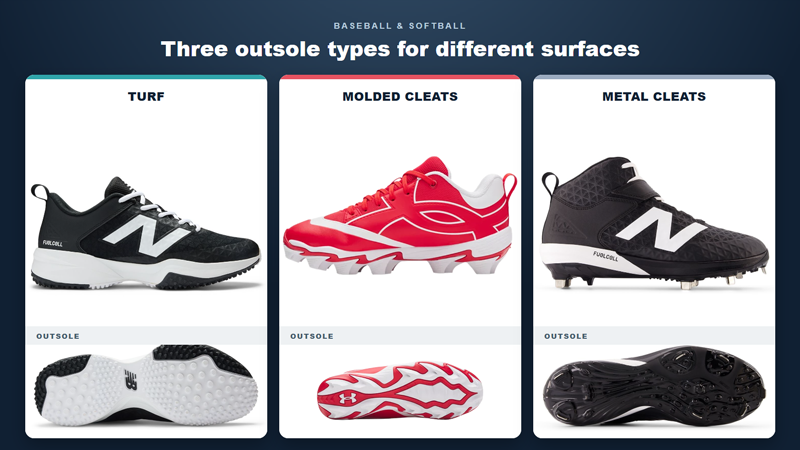
Turf, molded cleats and metal cleats: what is the difference?
| Sole type |
When to consider him |
What to check before buying |
| Turf - many low rubber bumps |
Artificial turf, some halls and a dry training surface. |
Pitch guidelines and grip on a specific surface; it may not be enough on wet natural grass. |
| Molded cleats – molded cleats made of rubber or plastic |
A common choice for natural grass and clay, especially for youth and mixed pitch programs. |
Check the material and shape of the cleats, the competition rules, and whether the specific artificial field allows this type of sole. |
| Metal cleats – metal cleats |
Natural surfaces if permitted by the competition and course and the player is comfortable with their grip. |
Age and competition category, local ban and ban on artificial surface or indoor. |
The label "plastic tips" is widespread in stores. Differentiate molded cleats from hard individual spikes similar to metal. Some competitions judge the construction of the sole, not just the material in the product name.
When to choose turf shoes?
Turf sole has many shorter rubber points spread over a larger area. It is suitable for training on artificial turf and on areas where long spikes are prohibited. However, this does not automatically mean that it is allowed in every hall or that it will hold as well as spikes on wet natural grass. Check the rules of operation of the sports ground and try the change of direction on the real surface.
If the team has part of its training indoors and part outside, different shoes for both surfaces may make sense. But check the trainer's requirements first on your first visit; no need to buy two pairs blindly.
Molded rubber and plastic lugs: a practical choice for many players
Shoes marked as molded cleats have lugs firmly formed into the sole. They provide traction on both grass and clay and are a practical first choice where metal spikes are not allowed. However, the protrusions differ in length, stiffness and shape. On artificial turf, follow the instructions of the groundskeeper; the mere word "plastic" on the label is not a confirmation that the shoe is allowed on the given surface.
If a player alternates training and matches on different courts, a well-fitting molded sole can be more versatile than a specialized metal pair. When choosing a specific model, also look at the width, heel support and the ability to comfortably stop and go sideways.
Metal spikes: only after checking the rules and the field
Metal spikes can bite into some natural surfaces better, but are not an automatic choice for an older or more experienced player. They may be prohibited on artificial turf, indoor and some pitching surfaces for both surface and safety reasons. In addition, they are more difficult to walk on hard surfaces outside the field.
Don't just buy them based on age. For example, the Little League rules differentiate the divisions: in the Major and lower leagues metal spikes are not allowed, while in the Intermediate, Junior and Senior Leagues they are. The 2026-2029 WBSC fastpitch rules prohibit metal spikes in the Youth and modified fastpitch categories. The Czech Softball Association in the specification of youth competitions 2026 states the prohibition of metal spikes for the mentioned youth categories. The current regulations of the specific competition and the local rules of the field always decide for your match.
How to choose the right size of baseball shoes?
- Measure the length of both feet standing from the heel to the longest toe. Follow the longer foot and measure in game-like socks.
- Compare the measured centimeters with the table specific model. US, UK and EU numbers may vary between manufacturers and between children's and adult ranges.
- After lacing, check that the heel does not slide significantly when walking quickly and changing direction, the toes are not compressed, and the upper is not pressing on the sides.
- Do not buy significantly larger shoes for children "in stock". If the size comes out between two models, compare the length in centimeters and the fit of both; just adding a number won't solve the width problem.
In the e-shop, you can find the shoe length in centimeters for a number of models directly in the size menu. Clothing size charts will help match the pants and other part of the uniform; do not determine the shoe size by them.
What to buy a child for the first training?
Confirm the surface and rules with the club first. For the first practice, the coach may allow regular sports shoes depending on the sports venue; for the next game on the field, he can already recommend shoes with molded protrusions. Buy metal spikes only when you have confirmed that the competition and the course allow them. For the shoes, prepare comfortable socks and spare shoes for the journey home, especially after a wet training session.
The full practical list can be found in instructions for the first baseball or softball practice.
FAQ
Are turf boots the same as cleats with plastic spikes?
No. Turf has many low rubber lugs, while molded cleats have more prominent lugs. You can tell the difference by the sole of the specific model, not just by the name in the store.
Can children play in metal spikes?
Depends on competition and category. They are prohibited in many youth rules, but the age limit is not the same everywhere. Check the current team and venue rules.
Is one shoe enough for all surfaces?
Sometimes yes, if the sole is allowed on all pitches in use and the player moves safely in it. Two different pairs may be suitable when alternating between artificial turf, hall and natural grass.
Where to next?
Once you know the surface, the rules, and the length of the foot, take a look baseball and softball shoes at BASEBALL-SHOP.online. For each model, check the sole type, length in centimeters and available sizes; the current offer may not include all three types of footwear.
Footwear Rules: Little League - metal cleats, WBSC - Official Rules of Softball Fast Pitch 2026-2029 a ČSA – specification of youth competitions 2026. Before the season, check the newer rules of your competition.